 A-TEC
A-TEC
 AEA Airguns
 AKAH
AKAH
 ASG
ASG
 Aimpoint
 Alpen Optics
 Alpha Industries
 Anschütz
 Antonio Zoli
 Ares
Ares
 B&T Schalldämpfer
 Baikal
 Ballistol
 Balzer
 Barbour
 Barnes
 Barnett
 Benelli
 Beretta
 Bergara
 Blaser
 Brandit
 Bremer Tresor
 Brenneke


The safe storage of centerfire cartridges is not only legally required but also protects against hazards such as damage from moisture or heat. It is important that you store the ammunition in a suitable, locked container that prevents unauthorized access. According to § 36 WaffG, you must ensure that neither ammunition nor keys are accessible to others.
The Most Important Points:
- Container: At least a steel cabinet with a swivel bolt lock is mandatory. For firearms and ammunition together: safes with resistance grade 0 or higher.
- Environment: Dry, cool (13–18 °C) and without temperature fluctuations. Humidity: 30–50 %.
- Keys: Store securely, never leave them out in the open.
- Inspections: Regularly check the storage location and the ammunition for damage or corrosion.
Tips:
- Use silica gel packets for moisture control.
- Label original packaging with purchase date and store older ammunition at the front.
- Immediately separate and dispose of damaged cartridges properly.
Adhering to these rules not only ensures the durability of the ammunition but also protects you from legal consequences.
Storage of Ammunition - In Detail !!!
Legal and Safety Technical Basics for Storing Centerfire Cartridges
Store Centerfire Cartridges Safely: Container & Requirements at a Glance
The Most Important Legal Requirements
German firearms law requires that centerfire cartridges must be stored in a steel container with a swivel bolt lock or an equivalent security measure [4]. A regular cabinet or an unsecured box is not sufficient.
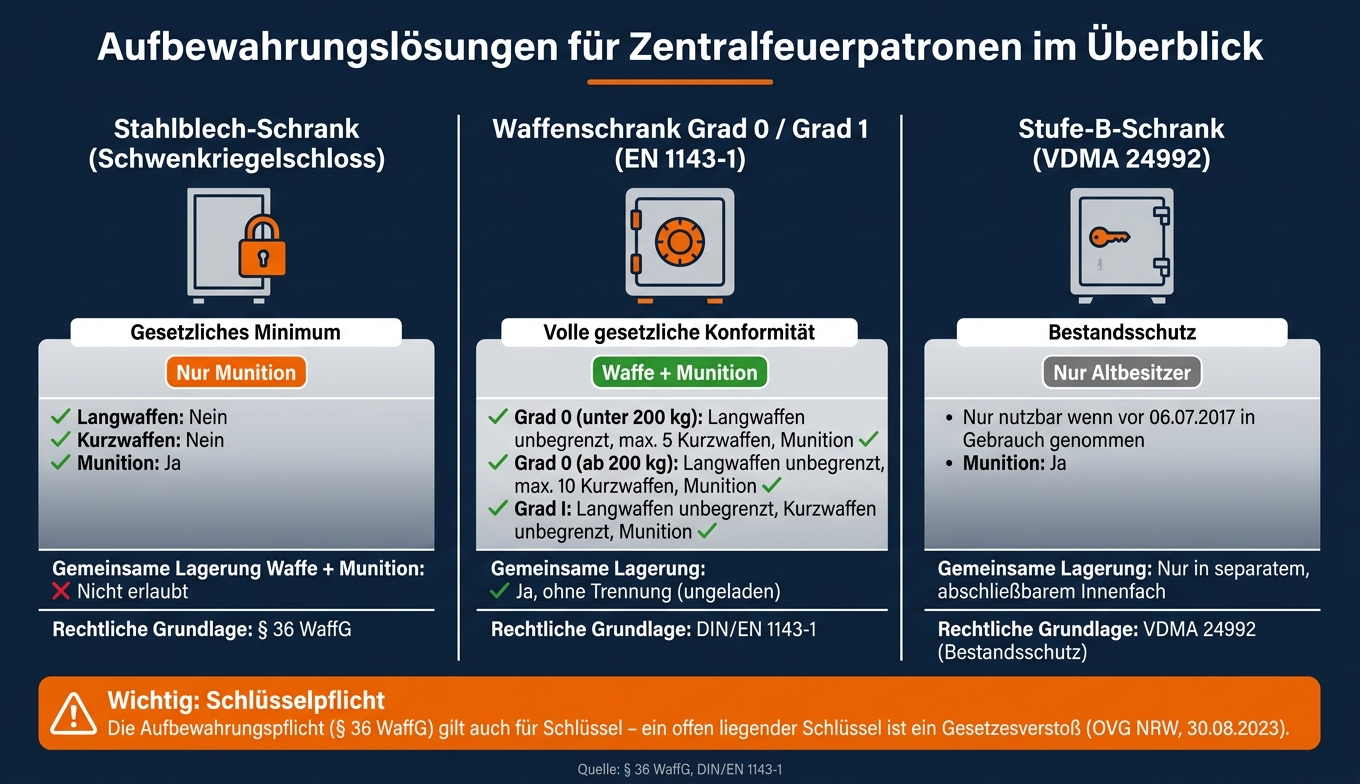
If you want to store ammunition and firearms together, stricter regulations apply. In this case, a certified security container according to DIN/EN 1143-1 is required. The following table shows which combinations are permissible:
| Container | Long Guns | Handguns | Ammunition |
|---|---|---|---|
| Resistance Grade 0 (under 200 kg) | Unlimited | Max. 5 | ✓ |
| Resistance Grade 0 (from 200 kg) | Unlimited | Max. 10 | ✓ |
| Resistance Grade I | Unlimited | Unlimited | ✓ |
| Steel Container | – | – | Only Ammunition |
Another important point: Safe storage applies not only to the firearms and ammunition but also to the keys to the respective containers.
Note: The obligation for safe storage explicitly includes the keys. The Higher Administrative Court of North Rhine-Westphalia confirmed this on August 30, 2023 (AZ. 20 A 2384/20):
“The obligation for the safe storage of firearms and ammunition (§ 36 Abs. 1 WaffG) also relates to the custody conditions of the keys." [5]
A key that is openly hanging on a key rack does not meet these requirements and already constitutes a violation of the law.
Once the legal requirements are clarified, you should also observe the following practical safety rules.
Safety Rules for Ammunition
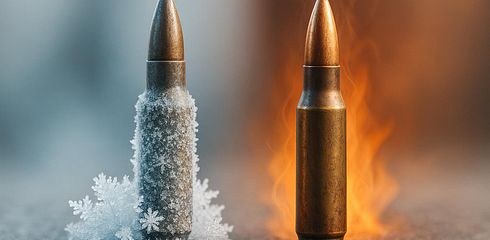
In addition to the legal regulations, there are some important safety aspects that you should consider: Centerfire cartridges are sensitive to heat, flames, and impacts, which can lead to unintentional ignition. Therefore, they should never be stored near heaters, fireplaces, or in vehicles that are exposed to direct sunlight in the summer.
Furthermore, it is crucial that you never share keys or combinations to safes with unauthorized persons – not even with family members without the appropriate firearms permit [4]. A violation can lead to the immediate revocation of firearms reliability, resulting in the loss of all permits [5]. To minimize risk, it is advisable to use an electronic safe that does not require physical keys.
Choosing and Preparing the Right Storage Location
Once the legal and safety technical requirements are clarified, the next step is to determine the ideal location for ammunition storage.
Finding the Suitable Storage Area
A dry, cool room that prevents unauthorized access is essential. Damp basements or garages that heat up significantly in the summer are unsuitable. Better options are indoor spaces with stable conditions, such as a storage room or a well-ventilated study [1]. Make sure to keep the storage area away from heat sources such as heaters or water pipes. To ensure additional protection, ammunition should preferably remain in its original packaging [1].
Controlling Temperature and Humidity
The optimal storage conditions are at a temperature of 13–18 °C and a relative humidity of 30–50%. Values above 70% can cause corrosion on cartridge cases and should be avoided [6]. These parameters not only support the legal requirements as described in § 36 WaffG, but also extend the shelf life of the ammunition.
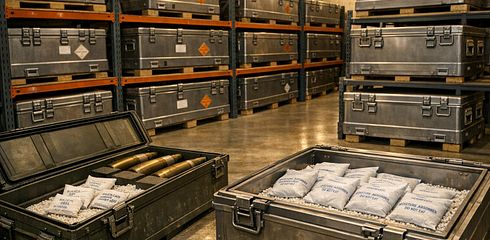
A simple and effective method for moisture control is silica gel packets. Variants with color indicators are particularly practical: Orange beads indicate that the gel is dry, while a color change indicates the need for regeneration. The gel can be dried in the oven at 80–93 °C for about two hours. As a guideline, use about 10–20 grams of silica gel per 100 cartridges [6][7].
Alternatively, electric dehumidifiers offer automatic regulation of humidity. However, these devices are more expensive and require a power supply.
| Method | Cost | Maintenance Effort | Power Requirement |
|---|---|---|---|
| Silica Gel | Low | Manual (Oven) | No |
| Electric Dehumidifier | Higher | Mostly Automatic | Yes |
Testing and Monitoring the Storage Area
Before storing the ammunition, the chosen room should be checked over several days. Temperature fluctuations or humidity spikes – for example, from an adjacent bathroom or weather changes – can be easily detected with a hygrometer and thermometer [6]. For long-term monitoring, a data logger that records temperature and humidity over an extended period is recommended [6]. This check should be repeated at least once a year. It is also important to check the seals of the storage containers.
Once the storage room has been tested and deemed suitable, you can focus on selecting the appropriate storage solutions.
Choose and organize the right storage solutions
Storage solutions that meet legal requirements
To store ammunition safely and in compliance with the law, a steel cabinet with a swivel bolt lock is the prescribed minimum [3]. This protects against unauthorized access and meets the requirements of § 36 WaffG.
“Otherwise, the legislator requires at least a simple steel cabinet with a swivel bolt lock for the storage of ammunition." – Matthias Kruse, Editor-in-Chief, Jagdpraxis [3]
If you want to store weapons and ammunition together, you need a gun cabinet according to EN 1143-1 (Resistance Class 0 or 1). In such safes, no spatial separation is required as long as the firearms are unloaded [1][3]. An example of this is the Hunter 2 Birkhuhn (VdS Class I), which is available for about €1,599.00 [9].
If you still have an old Class B cabinet (VDMA 24992, put into use before 06.07.2017), you can continue to use it exclusively for ammunition [3][8].
| Storage Solution | Legal Basis | Joint Storage of Weapon & Ammunition |
|---|---|---|
| Steel cabinet (swivel bolt lock) | Legal minimum for ammunition | No |
| Gun cabinet Class 0/1 (EN 1143-1) | Full legal compliance | Yes, without separation |
| Class B cabinet (VDMA 24992, grandfathering) | Only for existing owners before 06.07.2017 | Only in a separate, lockable compartment |
Once the appropriate cabinet is chosen, you can start organizing the ammunition clearly.
Organizing and Labeling Ammunition
If you have a legally compliant cabinet, it is important to clearly structure and label the ammunition. If you store multiple calibers or types of ammunition, a clear organization from the start ensures order. The original packaging provides an easy way to distinguish between different types of ammunition – caliber, manufacturer, and technical data are easily readable [1].
Additionally, you should label each box with the purchase date. This helps with consistent "First-in, first-out" usage: older ammunition is used first, while new is stored further back. Also, separate different purposes, such as training cartridges and hunting loads, to avoid confusion and to have the right one quickly available in case of an emergency.
A well-structured and labeled storage not only increases safety but also facilitates use. Keep purchase receipts or photos of the approval plaque of your safe – this way, you can easily prove during inspections that your solution meets legal requirements [3].
sbb-itb-1cfd233
Step-by-Step Guide to Storing and Maintaining Centerfire Cartridges
Taking Inventory and Sorting Ammunition
Before you store your ammunition, you should get a clear overview. Separate licensed from non-licensed ammunition, as both are subject to different legal requirements for storage [1]. A detailed inventory list is particularly helpful here: note the caliber, manufacturer, quantity, and purchase date. This list not only facilitates long-term control but also provides proof of proper storage to authorities [1].
The next step is to set up a secure storage container.
Setting Up and Maintaining Storage Containers
According to § 36 Abs. 1 WaffG, you are required to keep your storage cabinet locked at all times – even during short absences [2]. Lightweight steel cabinets should also be anchored to the masonry to prevent theft [1].
In addition to setup, regular maintenance is also important to ensure safety in the long term.
Regular Inspections and Adjustments
Once your storage solution is set up, you should check it regularly. The legal obligation for "necessary precautions" means in practice that you conduct a self-inspection every two to three months[2]. Pay attention to the condition of locks, hinges, and seals, as well as any signs of discoloration, corrosion, or deformation on the ammunition.
If your ammunition stock increases significantly, it is advisable to adjust your storage solution early. In cases of increased quantities or changed circumstances, authorities may impose stricter security measures and set a deadline[2]. Acting in a timely manner helps avoid unnecessary stress during official inspections.
Special Cases and Long-Term Storage
In addition to regular storage, handling ammunition in special cases or for long-term storage requires additional measures to ensure safety and functionality.
Tips for Long-Term Storage
Under optimal conditions – cool, dry, and without temperature fluctuations – modern ammunition can be stored for 10 to 20 years. However, moisture and temperature fluctuations significantly accelerate deterioration. Even a temperature increase of 5.5 °C can accelerate aging by 50 %[6].
To maximize shelf life, you should store ammunition in its original packaging following the FIFO principle (First In, First Out). Additionally, it is advisable to use about 10–20 g of silica gel per 100 cartridges to maintain humidity in the range of 30–50 %[1][6].
If you are away for an extended period, such as during a stay abroad, you can temporarily store your ammunition with an authorized dealer. This requires documentation but protects you from liability risks in case of potential incidents[1].
If individual cartridges show damage, special precautions are necessary.
Damaged or Corroded Cartridges
As soon as you discover damaged cartridges, you should immediately separate them from the rest of the stock. Typical warning signs include:
- Green coating on brass casings
- Rust on steel casings
- Visible powder leakage
- Loose bullet bases
Such cartridges must not be used anymore[6][10]. For disposal, contact your local police department or a licensed firearms dealer. The police usually accept dangerous or found ammunition free of charge and without legal consequences[4].
Important: Never use oil or petroleum to "clean" damaged cartridges. This can deactivate the primer and cause unpredictable reactions[6].
Similar caution is required if ammunition has been exposed to fire or water damage.
After Fire or Water Damage
If your storage area has been affected by fire or water, the rule is: Do not touch anything until professionals have assessed the situation. Heat can trigger chemical reactions in the ammunition that can lead to dangerous conditions such as a so-called squib load (bullet stuck in the barrel)[10]. Moisture causes corrosion and makes ignition unreliable.
“If you do not know how to safely check the loading condition of the firearm, please leave the firearm where you found it. Secure the location.” - Internetwache Polizei NRW[4]
Secure the area and prevent unauthorized access. Even after an incident, the legal storage obligation remains in effect[1]. The police can take care of proper disposal. Before using the affected container again, have the resistance class and tightness checked by a professional – both heat and water can permanently affect the structure[1][4].
Conclusion: The Most Important Aspects of Safe Storage of Centerfire Cartridges
Safe storage of ammunition requires attention and compliance with legal regulations. According to § 36 WaffG, you must ensure that ammunition neither gets lost nor falls into the hands of unauthorized persons – including family members – [2]. A violation can not only result in fines but, in the worst case, also lead to the loss of firearms reliability and hunting license [3].
In addition to legal requirements, storage conditions play a crucial role in the durability of your ammunition. A constant storage environment is essential: temperatures between 13 and 18 °C and a relative humidity of 30–50 % are ideal. To ensure these conditions, airtight containers, silica gel, and a stable storage location without temperature fluctuations are indispensable.
Regular checks are also important. Inspect your ammunition stock for corrosion, damage, and the condition of seals at least once a year. Keep purchase receipts and photos of the safety label, as the firearms authority can conduct an inspection at any time [3]. By consistently implementing these measures, you ensure a legally compliant and reliable storage.
If you want to optimize your equipment, you can find everything you need at Gunfinder: from silica gel packs to suitable ammunition containers to a wide range of centerfire cartridges – conveniently in one place and easy to compare.
FAQs
How do I store ammunition safely if I don't have a suitable room?
Even without a special room, you can store ammunition safely by keeping it in a locked and sturdy container, preferably made of steel. It is important that the environment is dry and cool – ideally between 15 and 21 °C with a humidity of 30–50 %. Avoid direct contact with the ground by placing the container elevated.
To control moisture in the container, you can use desiccants like silica gel and employ a hygrometer to regularly check the values. Also, ensure that the storage location is protected from water sources and flooding to prevent damage to the ammunition.
What signs indicate that cartridges are no longer safe?
Signs of unsafe cartridges can include misfires, chemical changes such as explosive crystals or acidic reactions. Additionally, deformations, rust, or corrosion should be taken seriously. If the firearm exhibits irregular behavior when firing, such as sudden drops in performance or blocked barrels, this is also a warning signal.
What should I do with ammunition after water or fire damage?
Damaged ammunition that has been affected by water or fire is no longer safe to use. Dispose of it in accordance with applicable local regulations to avoid hazards and damage to the environment. Moisture and high temperatures can trigger corrosion or chemical reactions that significantly compromise safety. Until safe disposal, the ammunition should be stored in a dry and tightly sealed container to prevent further damage.

 Auction