 A-TEC
A-TEC
 AEA Airguns
 AKAH
AKAH
 ASG
ASG
 Aimpoint
 Alpen Optics
 Alpha Industries
 Anschütz
 Antonio Zoli
 Ares
Ares
 B&T Schalldämpfer
 Baikal
 Ballistol
 Balzer
 Barbour
 Barnes
 Barnett
 Benelli
 Beretta
 Bergara
 Blaser
 Brandit
 Bremer Tresor
 Brenneke


Encryption is the core of modern data security. Whether for e-commerce platforms like Gunfinder or corporate infrastructures – choosing the right technology is crucial. However, alongside protection, speed also plays a role. This article highlights four key technologies and their characteristics:
- AES-256: Highest security, lightning-fast thanks to hardware support, ideal for large data volumes.
- RSA: Outdated, high computational load, but still compatible with older systems.
- ECC: Efficient, short keys, perfect for mobile applications and IoT.
- Post-Quantum Cryptography (PQC): Future-proof, but with performance challenges.
Conclusion: For current applications, AES-256 and ECC dominate. However, in the long term, there is no way around PQC to protect data from future quantum attacks.
1. AES-256
Security Level
AES-256 is considered one of the safest symmetric encryption standards. With a 256-bit key and 14 optimized transformation rounds, it offers protection that is practically deemed insurmountable [8][9]. The number of possible key combinations is 2^256, making brute-force attacks practically impossible [10].
"AES-256 is the strongest variant... it is used in areas where maximum security is required, such as sensitive data or government applications." – Michael Pedley, Cybersecurity Writer [8]
The US government has classified AES-256 as suitable for encrypting information at the highest level of confidentiality (“Top Secret") [9]. Attacks such as the Biclique attack have theoretically shown weaknesses, but are irrelevant in practice. Real threats come from side-channel attacks, such as power analysis. These can be effectively mitigated through constant-time implementations [8][11].
Performance Impact
Thanks to modern processors with AES-NI (Advanced Encryption Standard New Instructions), the performance of AES-256 is significantly improved. This hardware acceleration integrates cryptographic operations directly into the CPU, allowing AES-256 to be executed with minimal additional computational load [12][13].
| Parameter | Software (no AES‑NI) | Hardware (AES‑NI active) |
|---|---|---|
| Throughput | 150–400 Mbit/s | 1,500–8,000+ Mbit/s |
| CPU Load at 1 Gbit/s | 40–80 % | 2–10 % |
| Processing Latency | 10–50 µs per packet | > 50 % reduction |
At a data rate of about 10 Gbit/s, network I/O performance becomes the bottleneck, not the encryption itself. While hardware acceleration optimizes performance, the secure management of keys remains a central factor.
Key Management
AES-256 uses the same key for encryption and decryption as a symmetric algorithm. To ensure security, many systems combine asymmetric methods like RSA or ECC for key exchange with AES-256 for data encryption [10][3].
"Encryption is only as secure as the key management. The best algorithm with the longest key length is useless if the key is stuck to the monitor on a Post-it." – ISMS Lite Team [14]
For secure key management, the use of hardware security modules (HSM) or cloud-based services like AWS KMS or Azure Key Vault is recommended. Automated key rotations, for example every 90 days, further enhance security [14][15].
Application Areas
AES-256 has established itself as the standard for security-critical applications. It is used, among other things, in VPNs, disk encryption, and encrypted messengers. The algorithm is particularly important for platforms like Gunfinder, where the protection of transaction data and user profiles is of the utmost priority. The AES-GCM mode is preferred as it allows for parallel processing while providing integrated authentication to prevent data manipulation [8].
2. RSA
Security Level
RSA is based on a clear mathematical principle: the factorization of the product of two large prime numbers into its factors is extremely complex. It is precisely this difficulty that ensures the security of the method – provided that the key length is sufficient.
As of January 1, 2026, the BSI and the Bundesnetzagentur (BNetzA) in Germany mandate a minimum key length of 3,072 bits [18]. Keys with 1,024 bits have long been considered insecure, and 2,048-bit keys are also being gradually replaced. Those who want to be safe in the long term should already opt for 4,096 bits, especially if sensitive data needs to be protected for years.
"The use of the RSA algorithm with key lengths between 1900 and 3000 bits is inadmissible starting July 1, 2026." – gematik [17]
In July 2026, gematik GmbH migrated the German telematics infrastructure (TI) from RSA to ECC. RSA-only connectors and security module cards (SMC-B/HBA) had to be either replaced or updated, as RSA keys between 1,900 and 3,000 bits were no longer permitted for qualified electronic signatures (QES) [17].
Performance Impacts
Compared to symmetric methods like AES-256, RSA is significantly more computationally intensive. Therefore, it is rarely used in practice for encrypting large amounts of data. Instead, RSA is employed during the secure key exchange during the connection setup (handshake), while AES handles the actual data encryption. This hybrid model is standard in HTTPS transmissions [18].
Longer RSA keys increase CPU load. A 4,096-bit key offers more security than a 3,072-bit key but also requires noticeably more computing power. One optimization method is CRT-RSA (Chinese Remainder Theorem), which breaks down private key operations into smaller, more efficient sub-calculations [21]. Such performance challenges highlight the importance of thoughtful key management.
Key Management
In large RSA implementations, "Key Sprawl" can quickly occur – meaning orphaned or outdated keys (e.g., below 2,048 bits) that remain in systems and pose potential vulnerabilities [16]. To avoid this, it is advisable to use automated lifecycle management tools that centrally control tasks such as key generation, rotation, and revocation.
Private keys should always be stored in HSMs (Hardware Security Modules) or Cloud KMS – never in configuration files. When changing a key, it is advisable to use an overlapping validity period. This way, verifiers can accept both the old and the new public key, preventing outages [22].
Areas of Application
RSA remains indispensable due to its compatibility with older systems – especially when older hardware or software does not yet support ECC. For platforms like Gunfinder, where secure transactions and the protection of user data are essential, RSA continues to play a central role within a hybrid model.
However, the BSI recommends using classic RSA only until the end of 2031 – and for particularly high protection needs, even only until the end of 2030. According to the BSI, a complete transition to quantum-safe or hybrid signature methods should take place by 2035 [19][20]. Those planning for the long term should therefore consider RSA only as a transitional technology and initiate the migration to ECC or post-quantum hybrid methods now.
3. ECC
Security Level
ECC offers comparable security to RSA but requires significantly shorter keys. A 256-bit ECC key corresponds to the security strength of a 3,072-bit RSA key. To achieve a security level equivalent to AES-256, RSA would even need to operate with a 15,360-bit key, while ECC only requires about 512 to 521 bits [23].
“ECC provides the same encryption strength with shorter key lengths and thus more security, even when less computing power is available." – Lea Toms, GlobalSign [23]
However, ECC – like RSA – remains vulnerable to future quantum attacks by Shor's algorithm. Therefore, the BSI recommends using classical ECC for key exchange only until 2031 and transitioning to hybrid post-quantum models by 2032 [19].
Performance Impacts
ECC is significantly more efficient than RSA when it comes to creating signatures. For example, on a Nitrokey HSM 2, ECDSA-256 can achieve up to 360 signatures per minute, while RSA-2048 only reaches 100 signatures [26]. Key generation is also about five times faster with ECC. For platforms like Gunfinder, which need to secure many transactions simultaneously, this is a clear advantage.
Moreover, smaller ECC certificates reduce bandwidth consumption and latency during the TLS handshake. This is particularly beneficial for mobile users and applications with intensive API usage [25]. However, RSA still has a slight performance edge in signature verification [25]. In addition to performance, secure key management is also a central point.
Key Management
Private keys should always be stored in HSMs and never in configuration files. However, the nonce dependency of ECDSA poses specific risks. Here, Ed25519 offers an attractive alternative with compact keys and efficient operation [16].
“Ed25519 is fast, compact, and secure by default. It features short keys, efficient operations, and a design that avoids many pitfalls of older systems." – Encryption Consulting [16]
For key management, standardized and vetted curves such as Curve25519 or NIST P-256 should be used [27]. These measures are crucial for deploying ECC securely and effectively across various application areas.
Application Areas
Due to its efficiency and security advantages, ECC is ideal for modern applications – especially in areas such as IoT, mobile applications, and heavily frequented web services, where computing power and battery life are limited. One example is the German telematics infrastructure (TI), which is being transitioned from RSA to ECC by July 2026. This required the replacement of around 4,400 “RSA-only" connectors and the adaptation of millions of health cards [17][24].
For systems with older clients, a dual-stack approach is recommended: Modern connections use ECC certificates, while RSA serves as a fallback for outdated systems [25]. For SSH and digital signatures, Ed25519 should be preferred where possible, while RSA is only used where ECC is not supported [16].
4. Post-Quantum Cryptography
Security Level
Currently, RSA and ECC dominate cryptography, but the demand for quantum-safe alternatives is growing, especially for data that must be protected long-term. The reason: Quantum computers could solve the underlying mathematical problems of RSA and ECC in a short time using Shor's algorithm. In contrast, post-quantum cryptography (PQC) methods are based on mathematical problems such as lattice mathematics (ML-KEM, ML-DSA), hash functions (SLH-DSA), or code theory (Classic McEliece), which are difficult for both classical and quantum computers to penetrate [28][7].
A particular risk is posed by the “Harvest Now, Decrypt Later" strategy: Attackers can collect encrypted data today to decrypt it later with powerful quantum computers. For data with long confidentiality obligations, PQC thus becomes an urgent necessity [28][4][7].
“We encourage organizations to begin their transition to these standards immediately to ensure their data remains secure in the quantum era." – Dustin Moody, Head of the PQC standardization project, NIST [28]
Performance Impacts
While PQC algorithms provide protection against quantum attacks, they come with performance drawbacks. The TLS handshake can slow down by up to 30% because the keys and signatures are significantly larger [2]. These larger data sizes can lead to packet fragmentation in networks with small MTU values, which is particularly problematic for real-time applications [29].
Lattice-based methods like ML-KEM and ML-DSA prove to be particularly efficient for high-frequency systems. Benchmarks show that algorithms like Dilithium 2 and Falcon 512 can even enable faster TLS handshakes than RSA-4096 [30]. Hash-based approaches like SLH-DSA, on the other hand, are excellent for firmware signatures or long-term archiving.
Key Management
The introduction of PQC brings additional challenges in key management. Unlike RSA, PQC algorithms are often specialized: ML-KEM is used for key exchange, while ML-DSA or SLH-DSA are used for signatures. This means that platforms must manage multiple key pairs in parallel [32].
Another hurdle: Many hardware security modules (HSMs) and VPN concentrators do not yet support PQC. For many organizations, corresponding hardware upgrades will only be available between 2027 and 2028 [1].
A practical transition is the hybrid approach, where classical methods like X25519 are combined with ML-KEM. This keeps the connection secure even if an algorithm turns out to be less robust [6][7]. Automated certificate management (CLM) is becoming increasingly essential [32].
Application Areas
In August 2024, NIST adopted the first three PQC standards: ML-KEM (FIPS 203), ML-DSA (FIPS 204), and SLH-DSA (FIPS 205) [7]. Implementation is progressing rapidly: The Bundeswehr has equipped its 13,000-kilometer-long fiber optic network with quantum-safe algorithms by March 2026 [7]. Apple has integrated the PQ3 protocol into iMessage and its operating systems starting from 2024/2025 [2][7]. Additionally, Cloudflare has been offering hybrid post-quantum key exchanges for TLS 1.3 across its entire edge network since 2024 [2].
For platforms like Gunfinder, the recommendation is: First, conduct a crypto inventory to identify all systems using RSA or ECC. Then, one can start with hybrid TLS configurations to make the transition gradually and without security gaps [31][1].
sbb-itb-1cfd233
TLS 1.3 vs AES-256: What's the Difference? (And Why You Need Both)
Advantages and Disadvantages in Comparison
Encryption Technologies Compared: AES-256, RSA, ECC & PQC
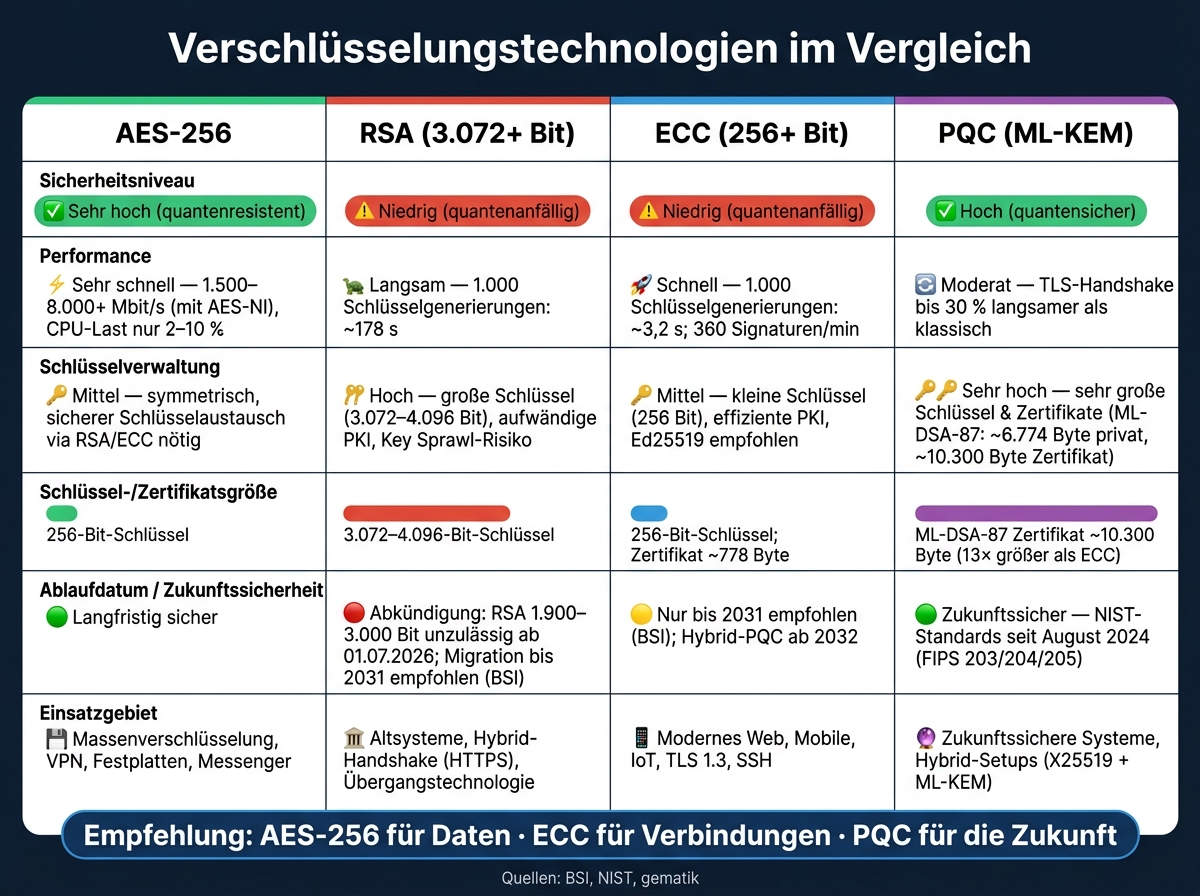
Each encryption technology has its own advantages and weaknesses. The following table provides a compact overview of four central criteria, so you can quickly see which method is suitable for which application.
| Technology | Security Level | Performance | Key Management | Application Area |
|---|---|---|---|---|
| AES-256 | Very high (quantum-resistant) [5] | Very fast, low overhead | Medium (secure key exchange needed) | Encryption of large data volumes (storage & transfer) |
| RSA (3.072+ Bit) | Low (quantum-vulnerable) [19] | Slow – 1,000 key generations: ~178 s [5] | High (large keys, complex PKI) | Legacy systems; will be phased out by 2031 |
| ECC (256+ Bit) | Low (quantum-vulnerable) [19] | Fast – ~3.2 s for 1,000 key generations [5] | Medium (smaller keys, efficient PKI) | Modern web, mobile, TLS 1.3 |
| PQC (ML-KEM) | High (quantum-safe) [7] | Moderate – comparable to ECC, but larger data packets | Very high (very large keys & certificates) | Future-proof systems, hybrid setups |
One aspect that is not directly visible in the table is the size differences in keys and certificates. For example, a private ECC-P256 key is about 241 bytes in size, while an ML-DSA-87 key is around 6,774 bytes [5]. The same applies to X.509 certificates: An ECC certificate requires only 778 bytes, while an ML-DSA-87 certificate is about 10,300 bytes in size [5]. This 13-fold difference has direct implications for bandwidth, storage requirements, and network traffic, which is particularly relevant in data-intensive applications.
For platforms like Gunfinder, which are used by many users simultaneously to search, buy, and compare offers, such differences are crucial. ECC remains the most efficient choice for TLS connections. However, in the long term, PQC will be indispensable, especially when it comes to protecting sensitive data over many years.
„Key Management is the actual core problem: Who creates keys, where are they stored, how are they rotated, and what happens in case of loss? Without clean Key Management, encryption is worthless." – ISMS Lite Team [14]
AES-256, a symmetric encryption method, is considered quantum-resistant and remains the preferred standard for encrypting large amounts of data – provided that the key exchange is done securely using an asymmetric method.
Conclusion
Every technology has its own strengths – the right application always depends on the specific use case.
AES-256 remains the benchmark for mass encryption: fast, efficient, and secure against quantum attacks – provided that the key exchange is done using a suitable asymmetric method. RSA, on the other hand, is outdated: As of July 1, 2026, RSA keys with a length between 1,900 and 3,000 bits will no longer be permitted [17]. If you are still using RSA, it is high time to start the migration.
ECC is the most efficient option for modern applications: Mobile apps, IoT devices, and TLS connections benefit from the small keys and high speed. However, while ECC excels in current systems, it is becoming clear that Post-Quantum Cryptography (PQC) will be essential for long-term protection. The BSI recommends migrating critical systems by no later than 2030 [33][34]. For data with a protection requirement of ten years or more, a hybrid approach of ECC and ML-KEM should already be standard today. Attackers are already collecting encrypted data to decrypt it later with quantum computers.
“Migrate now to be secure later." – Fraunhofer AISEC [7]
This overview shows how important a comprehensive approach in cryptography is. There is no solution that covers everything. Those who use AES-256 for data, ECC for connections, and PQC for the future are well prepared. Take a close look at your system landscape – those who know where which algorithms are used can quickly and specifically switch to future-proof encryption.
FAQs
When is AES-256 not sufficient on its own?
AES-256 is considered extremely secure, but when data needs to remain confidential for many years, conventional encryption methods reach their limits. The reason: Quantum attacks, such as the Grover algorithm, can significantly reduce the effective security of AES-256.
The Federal Office for Information Security (BSI) therefore warns that by the years 2030/2031 at the latest, new approaches will be necessary. Crypto-agile, hybrid solutions are recommended. These combine classical encryption methods with post-quantum cryptography to counter the threat posed by quantum computers. Pure asymmetric encryption or the lack of a clear migration strategy could prove risky in the future.
How do you recognize if your TLS still uses RSA?
You can determine if your TLS still uses RSA by checking the Cipher Suite negotiated during the connection establishment between your browser and the server. Cipher Suites like TLS_RSA_WITH_AES_128_GCM_SHA256 are considered outdated as they do not provide Perfect Forward Secrecy (PFS).
To find out which Cipher Suites your server actively uses, you can use specialized tools or analysis websites. These provide you with a detailed overview and help identify potential security vulnerabilities.
When does PQC (Hybrid) really make sense?
The use of Post-Quantum Cryptography (PQC) in a hybrid approach is already sensible today – especially when it comes to data that must remain confidential in the long term. Information that falls under the concept of Harvest Now, Decrypt Later is particularly at risk, where attackers collect data to decrypt it later with powerful quantum computers.
A hybrid approach combines classical encryption with PQC to create an additional layer of security. Considering the requirements of the Federal Office for Information Security (BSI), which calls for the migration of sensitive systems by the end of 2030, it is crucial for companies to take action early. This includes creating inventories, planning transition strategies, and conducting pilot projects to be prepared.

 Auction