 A-TEC
A-TEC
 AEA Airguns
 AKAH
AKAH
 ASG
ASG
 Aimpoint
 Alpen Optics
 Alpha Industries
 Anschütz
 Antonio Zoli
 Ares
Ares
 B&T Schalldämpfer
 Baikal
 Ballistol
 Balzer
 Barbour
 Barnes
 Barnett
 Benelli
 Beretta
 Bergara
 Blaser
 Brandit
 Bremer Tresor
 Brenneke


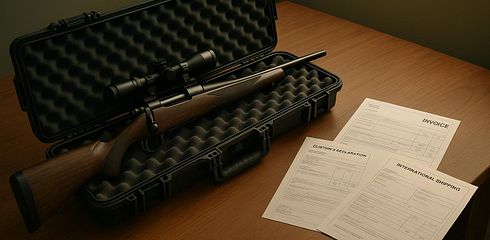
When shipping firearms, strict legal requirements apply in Germany. In addition to safety and protection against damage, legal requirements such as neutral packaging and recipient verification must also be observed. The right packaging not only determines the protection of the firearm but also the legal and financial effort involved.
Important Points:
- Legal Requirements: Firearm must be unloaded, neutrally packaged, and handed over only to authorized recipients.
- Packaging Materials: Double-walled corrugated cardboard, hard cases, and foam inserts offer different advantages depending on the type of firearm.
- Costs and Environmental Protection: Materials like paper padding are recyclable and cost-effective, while foam is more expensive and less environmentally friendly.
- Recommendation: The “Three-Layer Principle” (hard case, padding, sturdy cardboard) offers optimal protection.
Quick Comparison:
| Packaging Material | Stability | Moisture Protection | Cost | Recyclability |
|---|---|---|---|---|
| Corrugated Cardboard | Medium | Low | Low | High |
| Hard Case | Very High | Very High | High | Medium |
| Foam Inserts | High | Medium | High | Low |
The choice of material depends on the type of firearm, the mode of transport, and the budget. Careful packaging not only protects the firearm but also helps avoid legal consequences.
How to Box a Rifle for Shipment - CashMyGuns
sbb-itb-1cfd233
Legal and Safety Requirements for Firearm Shipping
In Germany, the shipping of firearms is subject to strict legal regulations that must be adhered to.
Safety Precautions When Packaging: Before shipping, the firearm must be completely unloaded – magazines and cartridges must be removed, and the bolt or lock should be packaged separately. Additionally, as the sender, you are required to verify the recipient's eligibility, for example, through a firearms ownership license, hunting license, or dealer license [1]. Handing over to an unauthorized person constitutes a serious legal violation.
Another important point is the recipient-bound delivery. The shipping service provider must be instructed to hand over the package exclusively to the authorized person – either via "Ident-Check" or "Eigenhändig". Delivery to neighbors, parcel stations, or by leave authorization is strictly prohibited [4].
“Neighbors are not a solution in weapon shipping, but a risk with a signature." – Roberto Ruscica, legal expert [1]
Neutrality of packaging: According to WaffVwV No. 36.3.3, the outer packaging must not contain any indications of the contents. This means no logos from gun dealers, no information about the caliber, and no adhesive tape with manufacturer printing [4]. At the same time, WaffVwV No. 36.3.1 stipulates that the transport service provider must be informed about the contents, even if the package appears neutral from the outside [4]. If the weapon is lost during transport, this must be reported immediately to the responsible weapons authority, no later than within 5 to 14 days (§ 37b Abs. 3 WaffG) [4].
Summary of legal requirements:
| Requirement | Legal Basis | Specific Measure |
|---|---|---|
| Recipient verification | § 34 Abs. 1 WaffG | Check WBK or hunting license before shipping |
| Recipient-bound delivery | § 34 Abs. 2 WaffG | Only order "Ident-Check" or "Eigenhändig" |
| Neutral packaging | WaffVwV No. 36.3.3 | No logos, caliber, or indications of weapons on the outside |
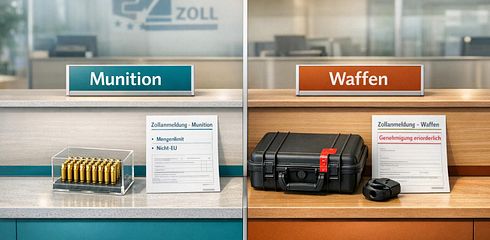
| Ammunition shipping | § 34 Abs. 2 WaffG | Closed packages, comply with ADR regulations |
| Loss reporting | § 37b Abs. 3 WaffG | Immediate report to the weapons authority |
These regulations not only provide the legal framework but also define the requirements for the packaging and safe shipping of weapons.
Criteria for the choice of packaging material
Not every material is equally suitable – errors in packaging can quickly increase overall costs by three to five times. Damage due to inadequate packaging often incurs significantly higher costs [8]. These criteria serve as a basis for comparing different packaging solutions.
Stability and Shock Absorption
Automated sorting systems place high demands on packaging. They must be able to absorb shocks, vibrations, and drops without any issues. Double-walled corrugated cardboard is the industry standard for outer packaging. This material can support the weight of a firearm without tearing or opening [2].
To securely fix the firearm, all cavities in the package should be filled with foam or bubble wrap. Rattling contents not only pose a safety risk but can also damage the packaging from the inside.
Moisture and Corrosion Protection
Metal and moisture are not a good combination. During longer transports or unfavorable storage conditions, condensation can occur. Hard-shell cases made of plastic or metal as the inner packaging layer provide reliable protection [2][3]. For additional protection, VCI materials (Volatile Corrosion Inhibitor) – special films or papers that actively protect metal parts from corrosion [8].
Bio-chips made from starch, on the other hand, are sensitive to moisture and are therefore unsuitable for shipping firearms when longer transport times or fluctuating temperatures are expected [8].
Costs and Environmental Impact
Filling and cushioning materials account for a significant portion of packaging costs – about 25 to 40 percent [8]. Prices vary significantly depending on the material:
| Material | Cost per Package (approx.) | Recyclability |
|---|---|---|
| Bubble Wrap | €0.05 – €0.20 | Medium (HDPE content) |
| Paper Padding | €0.10 – €0.40 | High (100% recyclable) |
| Bio-Chips | €0.15 – €0.50 | High (compostable) |
| Foam Inserts | €1.00 – €10.00 | Low (hardly recyclable) |
The EU Packaging Regulation (PPWR), which will apply from August 2026, mandates that all packaging must be fully recyclable by 2030 [8]. Materials such as expanded polystyrene (Styrofoam) are being gradually phased out of the market. Those currently relying on foam should transition early to paper-based or bio-based alternatives.
The next section will examine how these criteria are implemented in various packaging solutions.
Packaging Materials for Firearms: A Direct Comparison
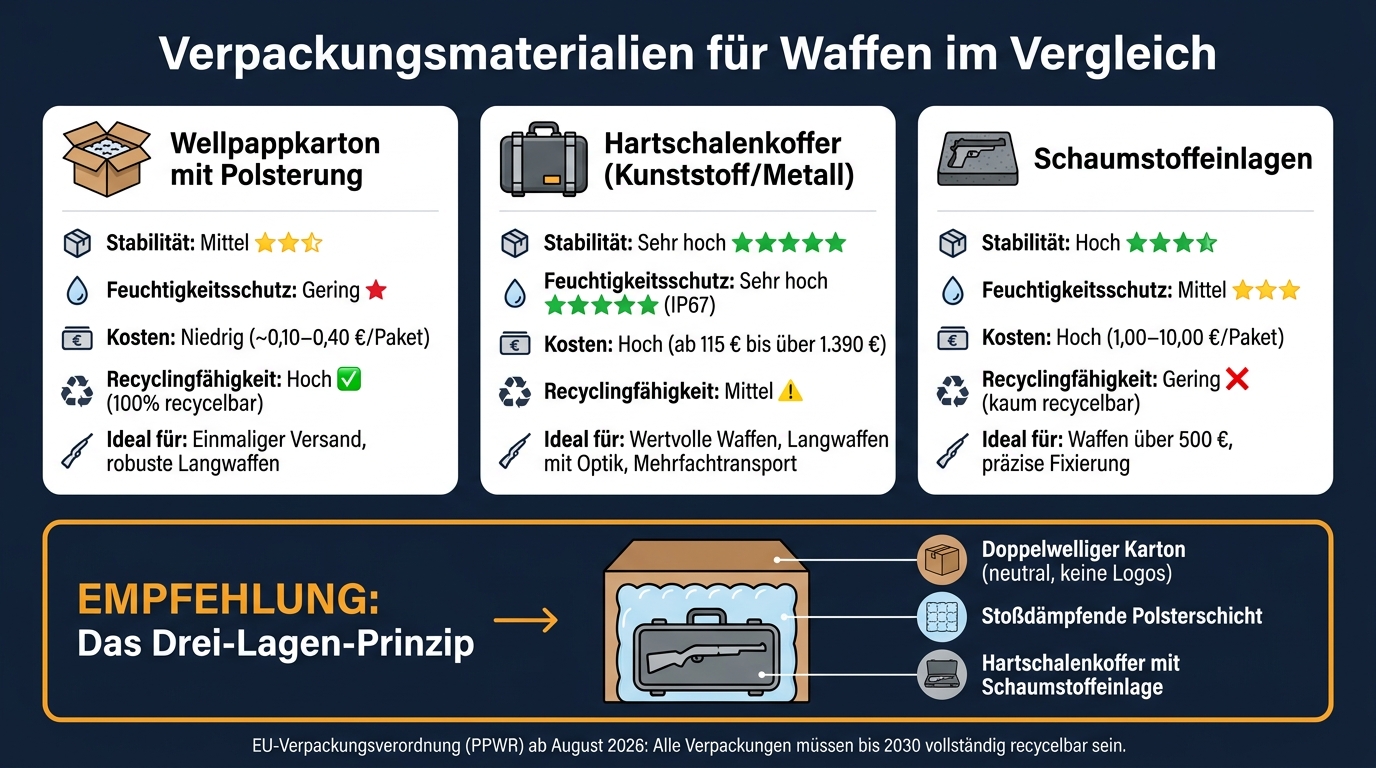
Packaging materials for firearms in comparison
Once the criteria are clarified: Which material offers the best protection? The three most common options vary depending on the level of protection, budget, and mode of transport. The following overview shows how the materials perform in the key aspects.
Corrugated Cardboard Boxes with Padding
Double-walled corrugated cardboard is a standard material. However, without additional padding such as bubble wrap or foam, the firearm may shift or become damaged [2][4]. This could not only lead to damage but, in the worst case, also legal consequences.
| Feature | Rating |
|---|---|
| Stability | Medium – okay with double-walled cardboard [2] |
| Shock Absorption | Depends on the filling material [2] |
| Moisture Protection | Low – absorbs water [4] |
| Cost | Low – suitable for one-time shipping |
| Recyclability | High – 100% recyclable |
Hard cases made of plastic or metal
Hard cases offer the best protection. High-quality models, such as the Explorer Cases, are often certified to IP67, meaning they are dust and waterproof, and can withstand temperatures from -33 °C to +99 °C [10][11]. Many models also meet air freight standards such as ATA 300 Cat. 1 [9]. However, they are heavier and more expensive. Complete sets cost between 330 € and over 1,390 € depending on the equipment [10][11].
For multiple transport and valuable optics, they are almost indispensable.
| Feature | Rating |
|---|---|
| Stability | Very high – shock, scratch, and break resistant [9] |
| Moisture protection | Very high – often IP67, with pressure valve [10][11] |
| Corrosion protection | High – airtight, acid-resistant [10] |
| Cost | High – from about 115 € to over 1,390 € [10][12] |
| Weight | Heavy – increases shipping weight |
Hard cases are ideal for valuable or frequently transported firearms, but they require a higher investment.
Foam Inserts and Other Padding Materials
Foam inserts provide precise support and reliably prevent movement. Custom-made inserts are particularly sensible for firearms worth over 500 €, as a single damage can quickly exceed the costs for high-quality padding material [8][13].
Air cushions, on the other hand, are only suitable for light and edge-less parts, as sharp metal edges can damage them [8]. Paper padding is a sustainable alternative that is particularly suitable for heavy components [8].
| Material | Protection Effect | Cost/Package | Environmental Balance |
|---|---|---|---|
| Foam Molded Parts | Very High (Precision) | 1.00 – 10.00 € | Poor – difficult to recycle [8] |
| Paper Padding | Good (Heavy Parts) | 0.10 – 0.40 € | Very Good – 100% recyclable [8] |
| Air Cushions | Medium (Void Filling) | 0.05 – 0.20 € | Medium – Plastic Waste [8] |
| Bio Chips | Medium (Light Parts) | 0.15 – 0.50 € | Very Good – Compostable [8] |
The Three-Layer Principle combines the advantages of all materials: The firearm is secured in a hard case (inner protective layer), which is placed in a shock-absorbing box with padding material (protective layer), and the whole is packed in a sturdy double-walled box (outer packaging) [2].
Depending on the firearm and transport requirements, you can choose the appropriate combination to ensure optimal protection.
Packaging by Weapon Type
Based on the previously explained packaging criteria, this section describes how different types of weapons can be packaged safely and efficiently. Factors such as size, weight, sensitivity, and the presence of a mounted optic play a central role. The following tips will help you find the right packaging solution.
Long Guns with Optics
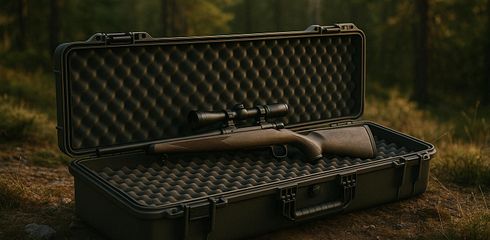
Long guns with mounted optics are particularly sensitive and require careful packaging. Even small shocks can impair the precision of the optics. The ideal solution is a hard case with a custom foam insert. This case is then placed in a neutral, double-walled cardboard box using the "Package-in-Package" principle [2][5].
The outer packaging should be large enough to accommodate the barrel, stock, and optics, for example, with dimensions of 118×26×8.5 cm (DHL compliant). It is also important to reinforce the ends of the box doubly to prevent the barrel from piercing through the packaging [14]. The bolt should be packaged separately to ensure additional protection [2][3].
For more robust weapons, different packaging requirements apply.
Shotguns and Robust Long Guns
Shotguns and other robust long guns without sensitive optics require less elaborate packaging solutions. A sturdy, double-walled cardboard box with sufficient padding is often sufficient, as long as the weapon is securely fixed and cannot move [2]. To keep the package more compact, the stock and bolt should be disassembled.
As mentioned earlier, standard parcel services generally accept packages up to a length of 120 cm [7]. If the dimensions exceed this limit, bulky goods surcharges of about €29.95 may apply. In such cases, it is advisable to use specialized providers like Waffentaxi, which offer shipping starting from €18.99 [6].
While robust long guns are usually sufficiently protected by a sturdy box, compact weapons require a different approach.
Handguns and Compact Weapons
Handguns are the easiest to pack. A small hard case with foam insert – available from about €14.72 – reliably protects against movement and moisture [15]. This case is then placed in a neutral outer box made of double-walled corrugated cardboard. Due to their compact size, handguns are particularly at risk of theft. Therefore, inconspicuous packaging without visible manufacturer logos is crucial [2][1].
„Poor packaging with some crumpled newspaper or packing paper and loosely placing a disassembled weapon does not meet the requirements for proper transport."
– Chris-Oliver Fricke, Lawyer [4]
Regardless of the type of weapon, a delivery option with personal delivery or identity check should always be chosen. This ensures that the package is handed over exclusively to the authorized person [1][5].
Conclusion
Safe weapon packaging is based on three essential aspects: Stability, Protection against moisture, and Cost control. The ideal solution is a packaging with three layers: a sturdy hard case inside, a shock-absorbing padding layer, and a neutral, double-walled outer box [2]. Those who save on packaging risk transport damage – and in the worst case, the loss of the firearms ownership card.
German firearms law allows no gray areas. Roberto Ruscica puts it clearly:
„Firearms law is not package delivery law, but a reliability issue." [1]
For shipping, this means: The packaging must be inconspicuous – without visible indications of the contents. Weapons and ammunition should always be transported separately. Additionally, it is essential to ensure personal handover through options such as “personal delivery” or an identity check [2].
On Gunfinder, buyers and sellers of hunting and sporting firearms come together daily. Use these tips to conduct every transaction safely and in accordance with legal requirements.
FAQs
What shipping method is allowed for firearms in Germany?
In Germany, the shipping of firearms is generally permitted, but it is subject to strict legal regulations as outlined in §34 Waffengesetz. A key point: The transfer of the firearm may only occur to a legally entitled person.
Important requirements for firearm shipping
- Suitable transport service provider: Use a provider that explicitly allows the shipping of firearms and ensures delivery directly to the recipient with identity verification.
- No dropping off or redirecting: Delivery to neighbors, parcel stations, or leaving at a drop-off location is not permitted.
These measures ensure that the shipping is conducted safely and in compliance with the law.
How do I properly package the bolt, magazine, and ammunition separately?
When shipping firearms and ammunition, it is important to adhere to strict safety precautions. Completely unload the firearm, remove the ammunition from the barrel and magazine, and package the bolt and firearm separately. Long guns should be disassembled into their individual parts and transported carefully padded.
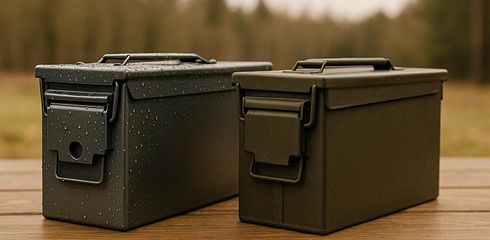
Ammunition must be treated as hazardous goods and shipped separately in a stable, secure packaging. Use cases or special transport boxes for transport and additionally secure the contents with padding materials such as bubble wrap to avoid damage and risks.
What packaging offers neutrality and protects against theft?
When shipping a firearm, protection and discretion should be the top priority. Use a sturdy, neutral box made of double-walled corrugated cardboard. Important: The box must not contain any indications of its contents.
To protect the package from tampering, you should use secure seals. Inside, a transport box or padded case provides additional protection. Materials such as foam or bubble wrap offer the necessary padding to ensure nothing shifts or gets damaged. It is important to securely fix all parts so that they do not move during transport.
For an extra layer of security, it is advisable to choose a shipping option with identity check or personal delivery. This ensures that the package is only received by the authorized recipient.

 Auction